
To strengthen corporate governance practices and disclosure requirements, Sebi has notified new rules, including that top 1,000 listed firms will have to formulate a dividend distribution policy. The regulator has also put in place a framework in relation to applicability, constitution and role of the Risk Management Committee (RMC) and eased norms for re-classification of a promoter as a public shareholder, according to a notification dated May 5. In addition, the regulator has asked listed firms to make available audio and video recordings of analyst and investor meets on their websites as well as stock exchanges within 24 hours or before the next trading day and also notified rules regarding Business Responsibility and Sustainability Report (BSSR).

For his first Budget in July 2014, Jaitley inherited a fiscal deficit target of 4.1 per cent of GDP. From 4.1 per cent, the fiscal deficit came down to 3.4 per cent by 2018-19, with two slippages from the budgeted targets, in 2017-18 and 2018-19, the former due to introduction of the GST, says Arup Roychoudhury.

The government would be ironing out issues related to the controversial 'bail-in' clause in the earlier Bill, explore hiking the deposit insurance cover of customers, and decide whether the resolution framework should apply to public sector banks.

The infra-major going belly up cracked open some major flaws in the system - the most evident being weak corporate governance and how layers of corporate structures could be formed adding to the opaqueness of the group.

Noted banker Uday Kotak said the country's financial system is currently in a Darwinian mode as only the fittest lenders are able to survive. Kotak also said that historically, whenever there has been a problem with a private sector lender, it has been merged with a state-run bank.

Has the Modi government been more at odds with institutions than other governments? There is no doubt that there have been more run-ins. While the RBI and CBI cases have drawn attention, there have been others, less publicised, Subhomoy Bhattacharjee points out.

Bad loans continue to originate mainly from state-owned banks, where the top management's responsibility is not linked to career prospects nor has legal consequences, says Debashis Basu.
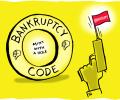
The government is also planning to set up specialised Benches for competition law to reduce the burden of the appellate tribunal, which is referred to on all matters from company law and IBC to competition law and the national financial reporting authority.
Bankers say debt resolution bills are coming high as resolution professionals are giving the human resources and audit/legal consulting to outside firms to plug all the loopholes.

To make sure liquid schemes reflect the underlying portfolio risks, Sebi has said all debt papers with maturity of 30 days or more to be marked to market. Earlier, fund houses didn't have to do so for securities that had less than 60-day maturity.

It would be a good idea to create independent oversight committees for each regulatory institution and indeed, even for their appellate bodies, says A K Bhattacharya.

A paper authored by Rajan said, state-linked banks can be a first step in altering the ownership structure of some PSBs, where the government brings down its stakes to below 50 per cent, creating distance from operations of banks, and improving governance along the way.

Close to a million small shareholders have stake in nine NCLT-bound companies

China Development Bank takes Reliance Communications to NCLT over loan default

Among executives who have been approached are former president and CEO of IndiGo Aditya Ghosh, Wolfgang Prock Schauer, current president and Chief Operating Officer at IndiGo and Sanjay Kumar, Chief Strategy and Revenue Officer of IndiGo.

The financial year ending Saturday saw such big-ticket events that set the directional tone for the country's business journey.
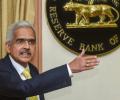
RBI says haste in easing norms for banks harmful to economy.

Essar group, Bhushan Steel and JSW group likely to be impacted by changes
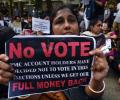
Only when the RBI inspection started on September 19 did they realise that their game was up and one of them had sent a letter to the central bank, leading to the RBI crackdown, report Anup Roy and Subrata Panda.

Under the plan, the government has categorised IL&FS group companies into green, amber and red based on their respective financial positions.

Falling private sector investment and farm distress are problems that call for immediate attention, says T N C Rajagopalan.

From promoters losing their firms to consumers realising there are no free lunches, 2019 was a year of getting real,says Shailesh Dobhal.

The biggest achievement of demonetisation is that it has brought about a social revolution against black money and corruption, says Sukumar Mukhopadhyay.

'The entire government-owned banking system (excluding SBI) is now in the red.' 'But worse is to come,' warns T N Ninan.
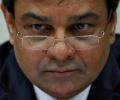
RBI has cited at least 10 areas where it has no control over PSBs.

13 eminent economists, including former RBI governor Raghuram Rajan and current International Monetary Fund Chief Economist Gita Gopinath, in a report have asked the political establishment not to resort to populist tricks.

'Every few days, I wake up with a sense of restlessness that time is running out'... 'We have created a due process for stressed assets to resolve, but there is no concrete plan in place for public sector bank balance sheets,' says RBI Deputy Governor Viral Acharya.

The contract has not only cemented the position of its chief executive officer (CEO) Abidali Neemuchwala, it has also proven the ability of the current management to successfully chase and close larger deals that are becoming scarcer in the market.

Of the seven surveys presented under Modi govt, predictions of three were quite close to the actual GDP growth rate, one saw the base year change in between, but the last three were way off the mark.

Governments that did not respect the central bank's independence would sooner or later incur the wrath of financial markets, ignite economic fire, and come to rue the day they undermined the regulatory institution, Deputy Governor Viral Acharya warned.

Some measures announced in Indradhanush -- a 7-point Modi plan to revamp State-owned banks but not completed -- may be taken up again.
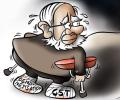
While GST and insolvency laws are among the major achievements of the Modi government, the list of failures include demonetisation, toxic banks, manufacturing hiccups and most prominently bizarre job creation figures. Mihir S Sharma takes a look at the four years of Modi government.

It had been pointed out to the banking regulator that one-day default was difficult to monitor in large companies, especially where cash flows are dependent on government payments.

While the formation of a holding company will not outright privatise State-owned banks, officials believe it will help the Centre deflect criticism arising out of the latest banking scams.

Till such time that a new governance framework comes into being, the progress of reforms in health, education, land, labour, electricity and agriculture could remain fraught with problems, agitations and delays, observes A K Bhattacharya.

Most of the unicorns or billion-dollar valuation firms including Flipkart, Paytm and Ola have had the maximum stakes owned by foreign funds. The founders of all these firms have either single digit stakes in their companies or in low double digits.

Analysts said with more power sector companies referred to the NCLT by banks, large companies would be at an advantage.

While three of the top five FPIs - Capital, Government of Singapore, and Vanguard - have seen their investment value more than triple, India's benchmark indices have risen just 70%.

As the government plans to take sector-specific steps to tackle the slump, Finance minister Nirmala Sitharaman will soon hold talks with representatives from various sectors to get and take steps so that the confidence of those sectors can be restored.
Experts consider Sebi's takeover code in its present form to be on a par with any foreign code governing public mergers and acquisitions.
 © 2026 Rediff.com - Advertise with us - Disclaimer - Privacy Policy - Sitemap - Feedback - About us - Terms of use - Grievances